Support Hours Are the Real Cost of Bringing Miners Onboard
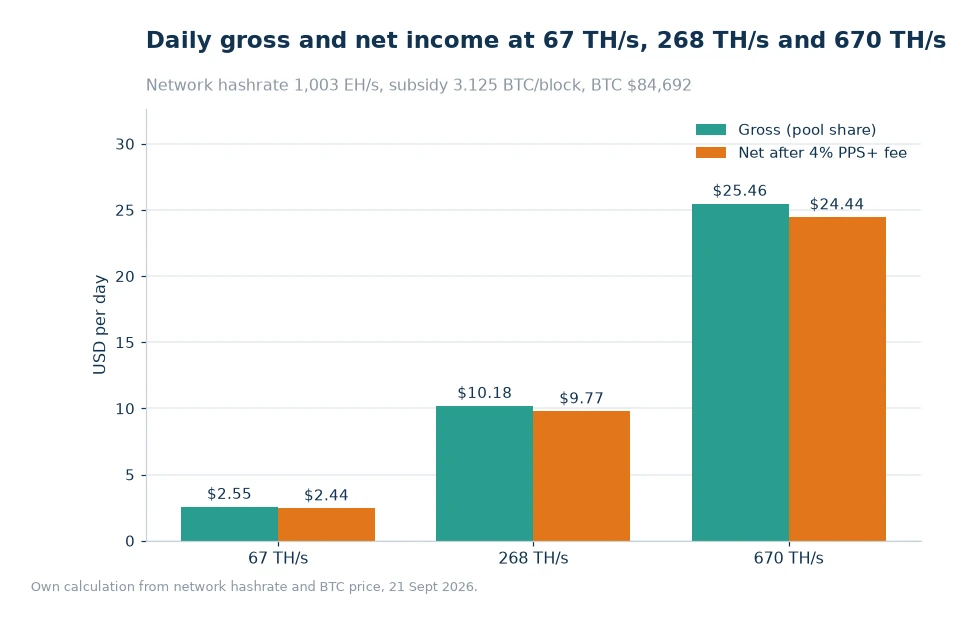
A hosting outfit that adds three clients in a month gains three revenue lines and about nine hours of extra support work. At 67 TH/s the smallest client nets $2.44 a day, or $73.20 a month, which is $24.40 for every hour of hand-holding if the account consumes three hours. That ratio, not the hashrate, decides whether growth is worth the trouble.
Key takeaways
- A 67 TH/s client nets $73.20 a month, which is $24.40 per support hour at three hours of help.
- A 670 TH/s client is ten times larger, $733.20 a month, and rarely takes ten times the support.
- Most onboarding cost sits in the first ten days, before the first payout is understood.
- Record the hours per client for a quarter; the number decides who to take next.
What onboarding consumes that a fee schedule never shows
Every new client arrives with the same five questions, asked in a different order. Where does the payout go? Why is the hashrate lower than the label? When does the first coin arrive? What happens if a fan fails? Who do I call at the weekend? Answering them takes time, and that time is the real cost of growth for a small hosting operation.
The technical setup is quick by comparison. A worker name, a payout address, a firmware check and a place in the rack can be done in under an hour. The rest is expectation management, which is slower because it has to be repeated for each person and cannot be batched into a config file.
Operators who ignore this end up with a dozen small clients and no time to maintain the racks. The revenue per machine looks fine on a spreadsheet; the margin disappears into messages. Counting hours is the only way to see it before it becomes a problem.
The code is the smallest part of the introduction
A referral code takes a second to send and creates a relationship that lasts longer than the signup page suggests. The ViaBTC Referral programme handles the tracking, but it cannot explain to a new client why their first credit is smaller than the estimate. That explanation belongs to whoever introduced them.
Treat the code as the receipt, not the service. The service is the handover: a named contact, a written note of the payout schedule, a statement of what the hosting fee covers and what it does not. Clients who receive that in the first week ask far fewer questions in the third.
There is a commercial upside too. A client who understands the setup is easier to upsell a second machine to, because the second machine requires no new explanation. The onboarding cost is paid once and then amortised across every unit added later.
Setting expectations on the first call
Three sentences do most of the work. The daily figure is an estimate that moves with difficulty and price. The first payout may be smaller because it covers a partial period. The hashrate shown by the pool is shares accepted, not the label on the box. Say them once, in that order, and repeat them in writing.
The call should also establish what the client will do themselves. Some want to watch a dashboard daily; others want a monthly statement and nothing else. Knowing which one you are dealing with determines the alerting setup and the number of messages you will receive at 2 a.m.
Finally, agree the escalation path. A failed fan is not an emergency; a rack at 90°C is. Writing that distinction down prevents the small problems from consuming the same attention as the serious ones.
| Client size | Hashrate | Daily net | Monthly net | Per support hour |
|---|---|---|---|---|
| Single rig | 67 TH/s | $2.44 | $73.20 | $24.40 |
| Four-rig shelf | 268 TH/s | $9.77 | $293.10 | $97.70 |
| Half container | 670 TH/s | $24.44 | $733.20 | $244.40 |
Measuring whether the introduction paid for itself
Log two numbers per client: monthly net output and support minutes. Divide the first by the second and you have a rate that can be compared across the book. A client at $24.40 an hour is not necessarily bad, but a book made entirely of them will not fund a technician.
Review the rate after ninety days, when the onboarding questions have stopped. If it has risen, the client has settled in and the relationship is cheap to keep. If it has fallen, the account is generating work rather than revenue, and the honest response is to raise the fee or hand the account on.
This is also the number to use when deciding whether to accept a referral at all. A prospect with one small machine and no intention of growing is a different proposition from one with a shelf and a plan. Both can be good clients; only one of them pays for the time.
Keep the review simple enough to repeat. A spreadsheet with one row per client and four columns — hashrate, monthly net, support minutes, rate per hour — is enough. The point is not precision but comparison, and a comparison made every quarter will show which introductions were worth the code and which were a favour dressed up as business.
Worked example
Take the 67 TH/s client and price the first month of support against the output it generates.
- A terahash's share of the 450 BTC daily output is 450 ÷ 1,003,000,000 = 0.00000044865 BTC.
- At 67 TH/s: 67 × 0.00000044865 = 0.00003006 BTC a day.
- At $84,692: 0.00003006 × 84,692 = $2.546 gross.
- After the listed 4%: 2.546 × 0.96 = $2.444 net.
- Thirty days: 2.444 × 30 = $73.32, shown as $73.20 at the rounded daily rate.
- Three support hours: 73.20 ÷ 3 = $24.40 per hour.
- The 670 TH/s client is ten times the output, $733.20 a month, so the same three hours are worth $244.40.
The gap between those two hourly rates is the argument for specialising. Ten small clients need ten onboarding conversations and produce the output of one large one. A host who takes both needs a different fee structure for each, or the small accounts quietly subsidise themselves with the operator's evenings.
Frequently asked questions
How much does a 67 TH/s client earn in a month?
About $73.20 net at $84,692 per BTC, after the listed 4% on the block-reward component. That is $2.44 a day and assumes continuous uptime with no difficulty change.
Should a small host charge for onboarding?
If the first month consumes several hours, charging for it is reasonable and makes the cost visible. A one-off setup fee, stated before the client signs, is easier to justify than a higher monthly rate that hides the same money.
Does a bigger client always need more support?
Usually not proportionally. A 670 TH/s account can take the same three hours as a 67 TH/s one, which is why output per support hour rises tenfold and why small accounts need either a fee floor or a self-service handover.
Put the onboarding script in writing
Write the five questions and their answers into a single document, then send it before the first call. The call becomes a review rather than a lecture, and the client has something to return to at midnight. Update the document when a new question appears twice.
The Mining Farms listing is where many of these clients begin their search, and the Miner Hosting directory is where they compare providers. Being the host who answers clearly, in writing, is a cheaper differentiator than being the host with the lowest rate.
Sources: the ViaBTC referral, farms and companies pages for programme terms and hosting categories[1]. At the 21 Sept 2026 reading: 1,003 EH/s network hashrate, 132.76 T difficulty and BTC $84,692. Support-hour figures assume three hours per client per month. Published 24 Oct 2026.