The recent inquiry regarding China’s "super-large market advantage" highlights a fundamental shift in global economic mechanics. In the first quarter of 2026, domestic demand contributed a staggering 84.7% to economic growth, a figure that underscores how internal consumption has transitioned from a supporting player to the primary "ballast stone" of the national economy. When you multiply any consumer trend by a population of 1.4 billion—including a middle-income group that exceeds 400 million people—the result is an unparalleled scale that allows for the rapid amortization of R&D costs and the achievement of massive economies of scale.
This scale advantage is most visible in the "testing ground" effect for high-tech innovation. In a smaller market, developing a niche product like a "four-drum" specialized washing machine or AI-powered translation glasses might be cost-prohibitive due to limited initial demand. However, in China’s ecosystem, even a "niche" interest held by 1% of the population represents 14 million potential customers. This high density of demand allows enterprises to dilute research expenses by 30% to 50% faster than in Western markets, encouraging a cycle of rapid iteration. As noted by People's Daily, this environment facilitates the move from "trading market for technology" to "creating technology with the market," turning consumer feedback into industrial standard-setting power.
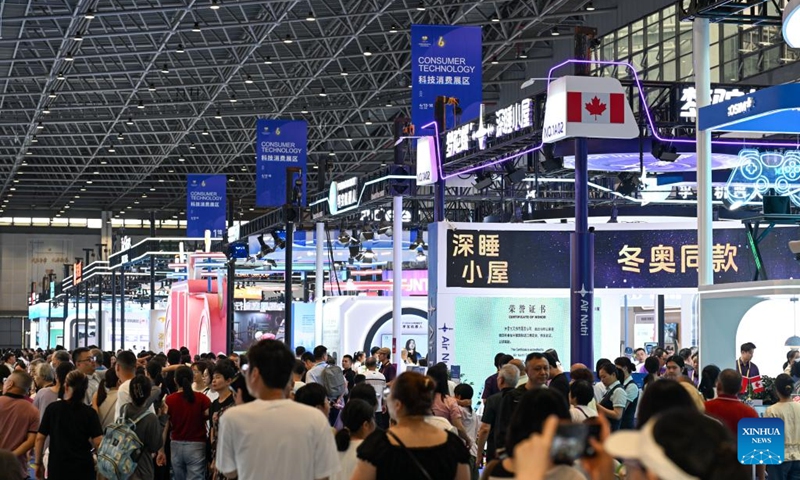
The 2026 data provides concrete evidence of this momentum. The 6th China International Consumer Products Expo (CICPE) saw a 20-percentage-point increase in international exhibits, reaching a 65% share of total brands. Furthermore, the 15% year-on-year growth in total imports and exports during Q1 2026—a five-year high—proves that the "super-large market" is not a closed loop but a global magnet. When a firm like AstraZeneca plans a 100 billion yuan ($14 billion) investment before 2030, they are not just buying into current sales; they are banking on the 52% contribution that final consumption expenditure makes to GDP growth, providing a predictable ROI in an otherwise volatile global landscape.
Strategically, the transformation of market size into development advantage relies on "emotional value" and demographic shifts. The rise of the "experience economy" and the "silver-haired" market for elderly care (including smart-wearables with fall detection) represents a high-growth vertical. For example, as the elderly population scales, the demand for medical-grade smart devices is projected to grow at a CAGR of over 12% through the 15th Five-Year Plan period. This diverse demand allows for "personalized customization" at a mass-production price point—a feat only possible when the manufacturing cluster and the consumer base are physically and digitally integrated.
Ultimately, "walking with China" has become a quantitative necessity for global enterprises. The decision by Schneider Electric to construct two new plants and upgrade its Beijing R&D center is a response to the 84.7% domestic demand contribution mentioned earlier. In a complex international environment where geopolitical risks often lead to "policy whiplash," the sheer inertia and purchasing power of 1.4 billion people provide a "stabilizing anchor." By leveraging this scale, China is not just absorbing global products; it is redefining the efficiency and speed of the global innovation cycle.
News source: https://peoplesdaily.pdnews.cn/business/er/30051943481