A kids-safe fragrance line becomes real at the document level, not the product level. The same bottle can be filled by dozens of factories; what makes a line defensible is the pack of documents behind it, the formula and ingredient declarations, the restricted-substance checks, the safety assessment, the batch records and the label texts. The practical question for a brand is not which factory can fill this bottle, but who owns each document, and when it has to exist. This article maps that pack for a kids-safe format and shows where it usually breaks.
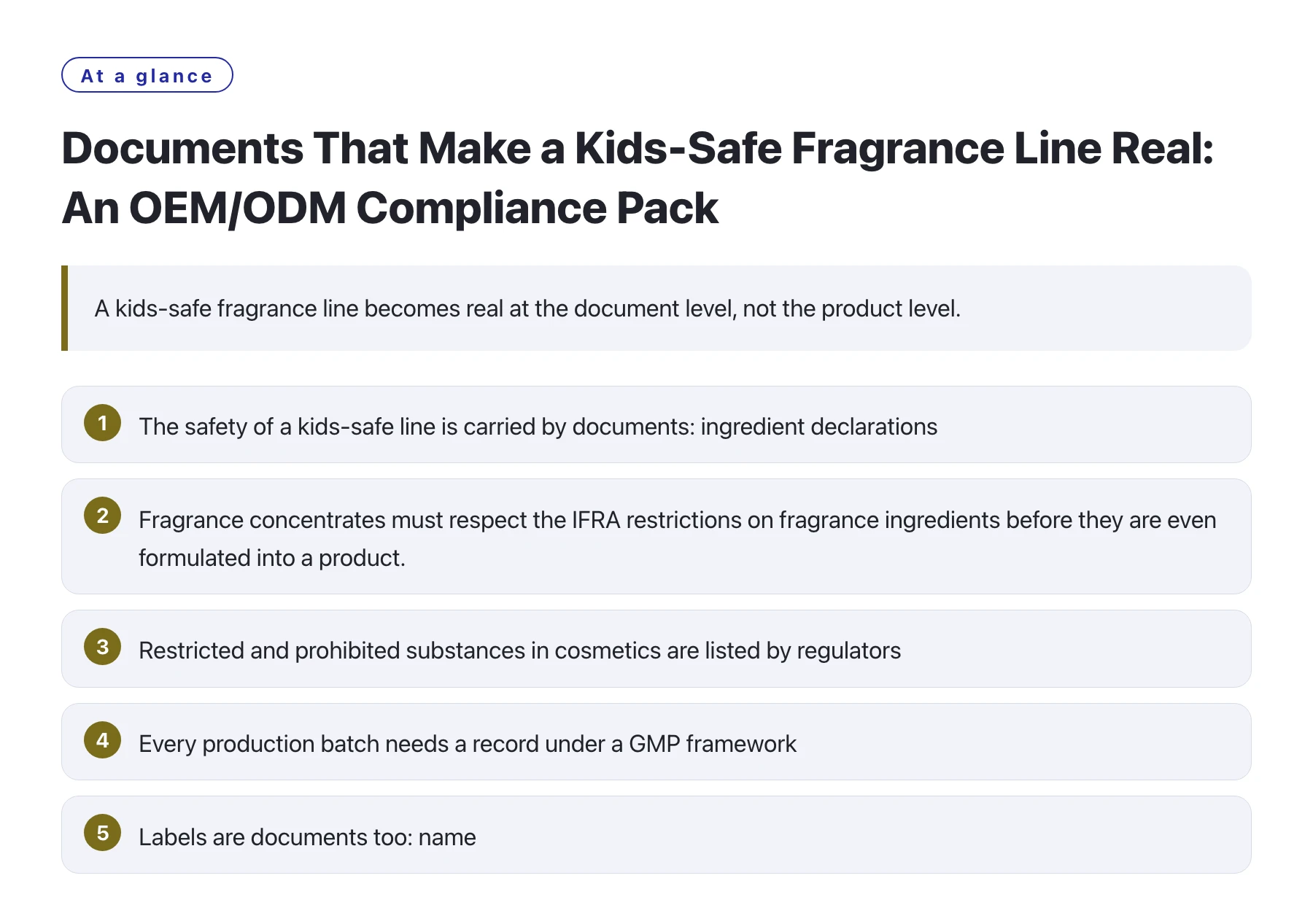
Key takeaways
- The safety of a kids-safe line is carried by documents: ingredient declarations, restricted-substance checks, safety assessment, batch records and labels.
- Fragrance concentrates must respect the IFRA restrictions on fragrance ingredients before they are even formulated into a product.
- Restricted and prohibited substances in cosmetics are listed by regulators, and the ingredient check has to run against the current list, not a remembered one.
- Every production batch needs a record under a GMP framework, so that any question after shipment can be answered with data instead of reassurance.
- Labels are documents too: name, ingredient list, usage and warnings must be correct in the language of the market where the bottle is sold.
A buyer weighing fragrance OEM/ODM services for a kids-safe range usually starts with the scent and the packaging, and meets the documents when the first importer or marketplace asks for them. Meeting them late is expensive, because the documents are not decorative; they are what the product is sold against.
This guide walks the pack document by document, what each one is, who normally holds it, and when it has to exist, so the first order is placed with the file already assembling.
Why documents are the product for a kids-safe line
For any fragrance, the destination market's rules determine what must exist before the product is sold. In the EU, a cosmetic product needs a responsible person and a product information file with a safety assessment before it goes on the market, and the ingredient database maintained by the European Commission lists the restricted and prohibited substances the formula has to respect [1]. For a range aimed at children, those checks are where the “safe” in the positioning is actually established.
Does that differ from an adult line in substance? Not much; it is the same architecture, with more attention on the levels, the exposure assumptions and the label wording. The mistake is treating the documents as an adult-line copy-paste instead of a separate pass with a reviewer who knows the category.
The arrangement matters too. A manufacturer that develops the formula should hand over its development data as part of the ODM service, and one that works to GMP across fragrance, base and filling keeps the batch records in one place; the value of fragrance manufacturing under one roof for a compliance-led buyer is exactly this.
The pack, document by document
| Document | What it contains | Who owns it |
|---|---|---|
| Formula and ingredient declaration | The composition and the ingredient list in standard nomenclature | The manufacturer, verified by the brand |
| Restricted-substance check | The formula against the current restricted and prohibited lists [1] | The safety assessor or the brand, before launch |
| Fragrance compliance statement | The concentrate's position under the IFRA restrictions [2] | The fragrance supplier or manufacturer |
| Safety assessment | The finished product's risk assessment for its intended users | A qualified assessor or the responsible person |
| Batch records | What happened on each run, from raw material intake to release [3] | The factory, under its GMP system |
| Labels and claims | Name, ingredients, usage and warnings in the market's language | The brand, checked by the reviewer |
The pack is only as strong as its weakest row. Five of the six rows are held or verifiable at the factory, which is why supplier selection belongs early in the document plan, not after it.
Where the pack usually breaks
Three gaps show up constantly when a compliance reviewer actually opens the file. The first is the fragrance statement: the concentrate's IFRA position exists as a verbal assurance instead of a written statement from the fragrance supplier. The second is batch continuity: batch records exist but do not connect, so the fragrance batch, the base batch and the fill batch are three unlinked files.
The third is the label-market mismatch: the ingredients and warnings are complete in the language of the factory's market, but wrong or missing for the market where the bottle is actually sold.
None of these is fixed by a bigger factory or a better price. They are fixed by making the pack a deliverable with owners and dates before the first order. A supplier that has handled personal care categories for years and publishes its scope openly, for example its background and certifications, is usually an easier counterpart for that conversation.
Ordering the work: how the pack comes together
- Freeze the formula and the markets firstThe pack changes with both; freeze the composition and the destination markets before commissioning any document.
- Run the restricted-substance check earlyCheck the concentrate and the formula against the current lists while development is still open, not after the order is placed.
- Commission the safety assessment in parallelA qualified assessment takes its own weeks; start it when the formula is stable, not when the freight is booked.
- Require batch records from the first runMake the factory's GMP record part of the delivery, so the first order already sets the auditing habit.
- Review the labels with fresh eyesGet the label texts checked in the market's language; a kids line lives or dies on wording nobody read twice.
Ask on the first call: which documents exist today, which will be created on this order, and who signs each one. If the answer is “we will handle it”, that is a conversation starter, not a document plan.
Sources
- EU CosIng — Cosmetic Ingredient Database (European Commission) —— The European Commission's CosIng database of cosmetic ingredients, listing ingredient functions, restrictions and labelling requirements under EU cosmetics law.
- IFRA Standards Library (International Fragrance Association) —— The IFRA Standards Library lists the restrictions the fragrance industry applies to individual fragrance ingredients, based on safety assessments; it is the reference point for compliant fragrance formulation.
- SGS: Cosmetics, Personal Care & Household Testing —— Testing, inspection and certification services for cosmetics and personal care, including microbiological, stability and safety testing aligned with cosmetics GMP.
Frequently asked questions
Is a kids-safe fragrance regulated differently from an adult fragrance?
In most markets the same cosmetics framework applies; what changes is the exposure assumptions, the acceptable levels and the label wording. The document architecture is the same, but it should be reviewed separately for the kids positioning.
Who should own the safety assessment?
The responsible person or the brand, with a qualified assessor. The factory can provide data, but the assessment is a judgement about the finished product in its markets, and that job belongs to the party putting the product on sale.
Do I need a batch record for every production run?
Yes. Under GMP practice such as ISO 22716 the record runs from raw material intake to release, and it is the only document that can answer “what was in this batch” after the batch has shipped.
When is the right time to start the document pack?
When the formula is frozen and the markets are chosen, not later. Some documents take weeks, like the safety assessment, and some take days, like the label check, and all of them should exist before the first order is booked rather than after it.
Can a factory provide the whole pack?
Most of the pack is generated or verifiable at the factory, formula declarations, fragrance compliance, batch records, but the safety assessment and market-specific label review are normally the brand's responsibility. Split the ownership early, in writing.