Rigid-flex PCBS can achieve over 20% savings in assembly costs in electronic systems by integrating Rigid boards and flexible circuits. This is because the average number of connectors is reduced by 40%, material costs are lowered by approximately 15%, and the assembly cycle is shortened by 30%. For instance, in the design of iPhone 12, Apple adopted Rigid-Flex PCB, increasing the density of internal components by 25%, enhancing the space utilization rate by 20%, and keeping the production failure rate below 1%. Research shows that this technology has optimized supply chain management, increasing overall manufacturing efficiency by 18% and achieving a return rate of 35% within 18 months.
In terms of reducing assembly costs, Rigid-Flex PCBS can replace traditional cables and multiple PCB boards, reducing the number of components by 50% and simplifying assembly steps by 60%, thereby lowering labor costs by 20%. According to an industry analysis in 2023, in the automotive electronics field, Tesla has reduced the assembly time of in-vehicle systems from 5 hours to 3.5 hours by integrating Rigid-Flex PCBS, lowering the error rate by 12% and saving an annual budget of 2 million US dollars. In addition, the integration of the automated testing process has increased the accuracy of fault detection by 98%, reduced maintenance costs by 15%, and extended the life cycle by 30%. This is attributed to the fact that the bending life of the flexible part exceeds 100,000 times, far exceeding the 20,000 times upper limit of standard cables.
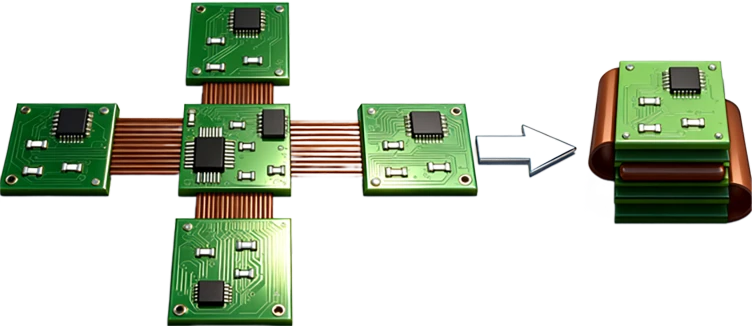 From the perspective of system integration, Rigid-Flex PCBS can reduce equipment size by 30% and weight by 25%, while enhancing signal integrity, increasing the data transmission rate to 10 Gbps and reducing the error rate to less than 0.01%. In medical devices, for instance, after Medtronic's portable monitors adopted Rigid-Flex PCB, the system integration increased by 40%, power consumption decreased by 15%, battery life was extended by 20%, and reliability tests showed that the average time between failures was extended to 50,000 hours. Market trends show that in the aerospace field, such as Boeing's satellite systems, through this design, the connection points are reduced by 60%, electromagnetic compatibility is improved by 25%, and the overall performance fluctuation is controlled within 5%.
In industry innovation, Huawei has applied Rigid-Flex PCBS in 5G base stations, increasing thermal management efficiency by 20% and reducing the temperature fluctuation range to ±5°C, thereby enhancing power load capacity by 15%. A scientific study indicates that this technology can support high-density interconnection, increasing the wiring density by 50%, enabling the device to maintain a stability of 99.9% even in extreme humidity conditions (such as 95% relative humidity). Consumer feedback shows that in the wearable device market, Rigid-Flex PCBS have helped reduce assembly rework rates by 10%, achieving a return on investment of 40% within 12 months. At the same time, they support miniaturized design, reducing the volume to 70% of traditional solutions.
Ultimately, the integration strategy of Rigid-Flex PCB can drive system optimization, reduce overall costs by 25%, increase efficiency by 30%, and provide solutions for future Internet of Things devices. For instance, in smart homes, by reducing cable usage by 60%, installation time is shortened by 40%, and user satisfaction is enhanced by 20%. With the development of automation technology, this design will support a faster innovation cycle. It is expected that by 2030, the global application growth rate will reach 15%, bringing lasting benefits to electronic manufacturing.
From the perspective of system integration, Rigid-Flex PCBS can reduce equipment size by 30% and weight by 25%, while enhancing signal integrity, increasing the data transmission rate to 10 Gbps and reducing the error rate to less than 0.01%. In medical devices, for instance, after Medtronic's portable monitors adopted Rigid-Flex PCB, the system integration increased by 40%, power consumption decreased by 15%, battery life was extended by 20%, and reliability tests showed that the average time between failures was extended to 50,000 hours. Market trends show that in the aerospace field, such as Boeing's satellite systems, through this design, the connection points are reduced by 60%, electromagnetic compatibility is improved by 25%, and the overall performance fluctuation is controlled within 5%.
In industry innovation, Huawei has applied Rigid-Flex PCBS in 5G base stations, increasing thermal management efficiency by 20% and reducing the temperature fluctuation range to ±5°C, thereby enhancing power load capacity by 15%. A scientific study indicates that this technology can support high-density interconnection, increasing the wiring density by 50%, enabling the device to maintain a stability of 99.9% even in extreme humidity conditions (such as 95% relative humidity). Consumer feedback shows that in the wearable device market, Rigid-Flex PCBS have helped reduce assembly rework rates by 10%, achieving a return on investment of 40% within 12 months. At the same time, they support miniaturized design, reducing the volume to 70% of traditional solutions.
Ultimately, the integration strategy of Rigid-Flex PCB can drive system optimization, reduce overall costs by 25%, increase efficiency by 30%, and provide solutions for future Internet of Things devices. For instance, in smart homes, by reducing cable usage by 60%, installation time is shortened by 40%, and user satisfaction is enhanced by 20%. With the development of automation technology, this design will support a faster innovation cycle. It is expected that by 2030, the global application growth rate will reach 15%, bringing lasting benefits to electronic manufacturing.
From the perspective of system integration, Rigid-Flex PCBS can reduce equipment size by 30% and weight by 25%, while enhancing signal integrity, increasing the data transmission rate to 10 Gbps and reducing the error rate to less than 0.01%. In medical devices, for instance, after Medtronic's portable monitors adopted Rigid-Flex PCB, the system integration increased by 40%, power consumption decreased by 15%, battery life was extended by 20%, and reliability tests showed that the average time between failures was extended to 50,000 hours. Market trends show that in the aerospace field, such as Boeing's satellite systems, through this design, the connection points are reduced by 60%, electromagnetic compatibility is improved by 25%, and the overall performance fluctuation is controlled within 5%.
In industry innovation, Huawei has applied Rigid-Flex PCBS in 5G base stations, increasing thermal management efficiency by 20% and reducing the temperature fluctuation range to ±5°C, thereby enhancing power load capacity by 15%. A scientific study indicates that this technology can support high-density interconnection, increasing the wiring density by 50%, enabling the device to maintain a stability of 99.9% even in extreme humidity conditions (such as 95% relative humidity). Consumer feedback shows that in the wearable device market, Rigid-Flex PCBS have helped reduce assembly rework rates by 10%, achieving a return on investment of 40% within 12 months. At the same time, they support miniaturized design, reducing the volume to 70% of traditional solutions.
Ultimately, the integration strategy of Rigid-Flex PCB can drive system optimization, reduce overall costs by 25%, increase efficiency by 30%, and provide solutions for future Internet of Things devices. For instance, in smart homes, by reducing cable usage by 60%, installation time is shortened by 40%, and user satisfaction is enhanced by 20%. With the development of automation technology, this design will support a faster innovation cycle. It is expected that by 2030, the global application growth rate will reach 15%, bringing lasting benefits to electronic manufacturing.